Ebook Enterprise Integration Patterns: Designing, Building, and Deploying Messaging Solutions
In reading this publication, one to bear in mind is that never worry and also never ever be tired to check out. Also a publication will certainly not offer you actual idea, it will certainly make excellent dream. Yeah, you can imagine getting the good future. But, it's not just sort of creative imagination. This is the time for you to earn appropriate suggestions to earn much better future. The means is by obtaining Enterprise Integration Patterns: Designing, Building, And Deploying Messaging Solutions as one of the analysis product. You can be so relieved to review it due to the fact that it will certainly give a lot more possibilities and also benefits for future life.
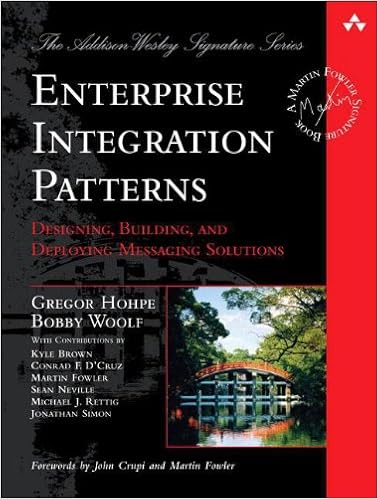
Enterprise Integration Patterns: Designing, Building, and Deploying Messaging Solutions

Ebook Enterprise Integration Patterns: Designing, Building, and Deploying Messaging Solutions
A service to obtain the issue off, have you discovered it? Truly? What kind of solution do you fix the trouble? From what sources? Well, there are many inquiries that we utter every day. Regardless of just how you will obtain the remedy, it will mean much better. You can take the referral from some publications. As well as the Enterprise Integration Patterns: Designing, Building, And Deploying Messaging Solutions is one book that we really advise you to review, to obtain even more remedies in fixing this trouble.
But, when a publication is incredibly popular, it will certainly go out swiftly. It is one of the matters that you should consider. After strolling for much distances to get this book, it will not guarantee you to find it. Often, you will certainly not find it in some shelfs. So, it will certainly be better for you to get guide in this area. By only clicking the web link and also discover the book rapidly, you could save it and also begin to review. This is exactly what you can feel so happy to earn much better for getting the qualified resource to read.
As a result of the skilled as well as expert performance of the writer, you could expose just how this book is located for making the excellent scenario. This is not just regarding your transforming suggestions. It has to do with just what book you need to review in this current era. As well as making you constantly really feel upgraded with the info, Enterprise Integration Patterns: Designing, Building, And Deploying Messaging Solutions is available and ideal enough to read.
recognizing even more concerning this publication, you can reveal how this publication is essential for you to review. This is just one of the reasons that you ought to review it. However, the here and now Enterprise Integration Patterns: Designing, Building, And Deploying Messaging Solutions can be suggested to get over the troubles that you encounter currently, probably. Also you have the right option, obtaining info as well as considerations from some other sources are requirement. You could have extra times to understand about the problems as well as how to solve it. When you require enjoyment to make enjoyable, you could obtain some from this publication.
From the Back Cover
Would you like to use a consistent visual notation for drawing integration solutions? Look inside the front cover. Do you want to harness the power of asynchronous systems without getting caught in the pitfalls? See "Thinking Asynchronously" in the Introduction. Do you want to know which style of application integration is best for your purposes? See Chapter 2, Integration Styles. Do you want to learn techniques for processing messages concurrently? See Chapter 10, Competing Consumers and Message Dispatcher. Do you want to learn how you can track asynchronous messages as they flow across distributed systems? See Chapter 11, Message History and Message Store. Do you want to understand how a system designed using integration patterns can be implemented using Java Web services, .NET message queuing, and a TIBCO-based publish-subscribe architecture? See Chapter 9, Interlude: Composed Messaging. Utilizing years of practical experience, seasoned experts Gregor Hohpe and Bobby Woolf show how asynchronous messaging has proven to be the best strategy for enterprise integration success. However, building and deploying messaging solutions presents a number of problems for developers. Enterprise Integration Patterns provides an invaluable catalog of sixty-five patterns, with real-world solutions that demonstrate the formidable of messaging and help you to design effective messaging solutions for your enterprise. The authors also include examples covering a variety of different integration technologies, such as JMS, MSMQ, TIBCO ActiveEnterprise, Microsoft BizTalk, SOAP, and XSL. A case study describing a bond trading system illustrates the patterns in practice, and the book offers a look at emerging standards, as well as insights into what the future of enterprise integration might hold. This book provides a consistent vocabulary and visual notation framework to describe large-scale integration solutions across many technologies. It also explores in detail the advantages and limitations of asynchronous messaging architectures. The authors present practical advice on designing code that connects an application to a messaging system, and provide extensive information to help you determine when to send a message, how to route it to the proper destination, and how to monitor the health of a messaging system. If you want to know how to manage, monitor, and maintain a messaging system once it is in use, get this book. 0321200683B09122003
Read more
About the Author
Gregor Hohpe leads the enterprise integration practice at ThoughtWorks, Inc., a specialized provider of application development and integration services. Drawing from his extensive experience designing and implementing integration solutions for enterprise clients, Gregor has published a number of papers and articles presenting a no-hype view on enterprise integration, Web services, and Service-Oriented Architectures. He is a frequent speaker at technical conferences around the world. Bobby Woolf is coauthor of The Design Patterns Smalltalk Companion (Addison-Wesley, 1998), and author of articles in IBM DeveloperWorks, Java Developer's Journal, and elsewhere. He has been a tutorial presenter at OOPSLA, JavaEdge, and Smalltalk Solutions, among other conferences. 0321200683AB09122003
Read more
See all Editorial Reviews
Product details
Hardcover: 736 pages
Publisher: Addison-Wesley Professional; 1 edition (October 20, 2003)
Language: English
ISBN-10: 9780321200686
ISBN-13: 978-0321200686
ASIN: 0321200683
Product Dimensions:
7.5 x 1.8 x 9.6 inches
Shipping Weight: 3 pounds (View shipping rates and policies)
Average Customer Review:
4.5 out of 5 stars
90 customer reviews
Amazon Best Sellers Rank:
#72,934 in Books (See Top 100 in Books)
This is an excellent book on the patterns and concepts in enterprise integration. I've been doing enterprise integration since this book was written with a middleware product (webMethods) and J2EE and finally got around to reading this book. I found the book to be very well written and easy to read: the authors walk you through different thought processes for solving a particular problem and why the pattern is the best solution. Even though the book is 15 years old as of my review it is still pertinent today.The patterns explain the different problems one typically needs to solve to do asynchronous messaging integration with legacy and modern applications.Many of the patterns are included in commercial middleware products like webMethods, Tibco, Mulesoft, etc. Others you will need to build yourself to solve specialized problems.The book examples are JMS and MSMQ centric, with a few Tibco examples too. The code examples are geared toward building solutions with those simple technologies rather than showing all of the middleware vendor tools. Therefore, I wouldn't read this book to learn how to code things. Read it to understand how asynchronous messaging problems should be solved, and to evaluation SOA and middleware products for features that implement these patterns.In the last few years SOA and microservices have been the buzzwords in enterprise integration, but there are still many patterns from this book you may use because there are still many legacy apps in use that can't be modified to directly support web services, and many tasks still need to be asynchronous and decoupled.
I've been a s/w architect for years so ... I've encountered most of these integration patterns. As I went through patterns that I haven't used, I kept the same question in my head: how is this better than if I just did it without a pattern (this is the same question I keep applying to frameworks and tools such as ESBs and business process orchestration languages like BPEL). With this, I found the authors thought along the same lines and were able to provide those answers without my having to think about the issue of not using the pattern. You have to know what the alternatives are that the pattern is trying to resolve and just why the alternatives are a problem -- and this book delivers on that. Note: I found it was helpful to keep in mind that these are application integration patterns: patterns for integrating applications as opposed to patterns for building an enterprise application.
Deserves to take place in the great line up of GoF, POSA1, POSA2, EAA, Core Security Patterns (other "patterns" books omitted intentionally).I have done Messaging and message based integration before, but this book takes essentially what is an art form and makes a science out of it.First it starts with 4 different styles of integration (File based, Shared Database, RPC, Messaging) and discusses them intelligently giving their advantages and disadvantages.Then it gets in to the major aspects/ pieces of Message based integration (Message, Channel, Routing, Transformation, End Points, System Management etc). It again discusses them as patterns and develops a good vocabulary of the messaging domain.Then comes the meat where for each aspect of Messaging, it gives about 8 to 15 specific patterns, names them, shows their pros and cons, gives the trade off and intelligently discusses their usage. As part of the examples it draws example from JMS/ TIBCO/ MSMQ etc. Priceless.What I loved about this book is how it makes you rethink everything you may have been doing before in software architecture/ integration using technologies such as Web Services, JMS, J2EE etc.For example, many would not have fully groked MDBs as "event driven", "competing", "transactional" message consumers, that are suited for "Point to Point" integration. Yes I know every body uses them but do you really understand the implications for transaction scope and threading? . Or Polling message consumers have their advantages ?Good discussion on relate standards and technologies included (Web Services, Axis Implementation, WS-*, SOAP etc)Buy this guys and may be enterprise integration would be less messy.
Arrived on time, used , but in very good and clean condition, almost like new.The book itself is very well written and organized. It gives very good real-life business integration examples. I believe anyone with some enterprise integration background can follow and relate to this book very easily, and without getting bored or falling asleep.
In the present resurgence of functional languages, this book should be highly regarded for its depth of focus on messaging patterns and their proper use. There aren't many books I'd say should be on every developer's bookshelf by they time they have a senior job title, but this is definitely one of them.
This is the third pattern book in my collection (the other two are Analysis Patterns by Martin Fowler and the definitive Design Patterns by the Gang of Four) and IMHO this is the best example yet of where patterns can really improve the development process. This is the first book I've seen to address the area of enterprise development where the real heavy lifting takes place. Applications don't miraculously integrate with one another; it takes talented, knowledgeable IT personnel to wire everything together. If you're one of those people, Enterprise Integration Patterns is an important addition to your toolkit.Chapter 2 takes the reader through the integration efforts of a fictional enterprise to demonstrate some of the patterns in action. The descriptions of the problems and their possible solutions... just make sense. You can really see the benefit that these patterns provide to simplifying, organizing and clarifying the situation.
Enterprise Integration Patterns: Designing, Building, and Deploying Messaging Solutions PDF
Enterprise Integration Patterns: Designing, Building, and Deploying Messaging Solutions EPub
Enterprise Integration Patterns: Designing, Building, and Deploying Messaging Solutions Doc
Enterprise Integration Patterns: Designing, Building, and Deploying Messaging Solutions iBooks
Enterprise Integration Patterns: Designing, Building, and Deploying Messaging Solutions rtf
Enterprise Integration Patterns: Designing, Building, and Deploying Messaging Solutions Mobipocket
Enterprise Integration Patterns: Designing, Building, and Deploying Messaging Solutions Kindle


0 comments:
Post a Comment